Troy Love Story – New WIP

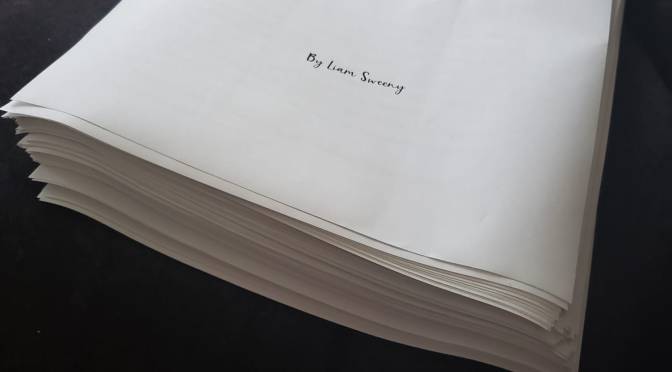
Manuscript on a coffee table.
My love for the next few months.

Hey everyone. Actually, hey, single one person who will end up reading this. I have a new project in the works. I am calling it various things. The file name is “Clouds Over Collar City Skies.” I don’t think that will make the cut in the end. The title on the pile of pages I’ve been printing out is ‘A Troy Love Story.’ I’m positive that title will go into the slush.

What’s it about? I had in mind a modern take on James Joyce’s classic, Ulysses, but centering around the city of Troy, NY during the month of December. It is about loss, struggle and the cost of redemption in the city that gave us Uncle Sam.

That’s about as much as I want to say on the topic. I’ll leave a shot of the manuscript so far. Talk to you soon!


Shawn A. Cosby – My Darkest Prayer, the Interview.

If you meet Nathan Waymaker, you probably don’t want it to be in a back alley. And you definitely don’t want to have wronged someone that’s in his good graces. And if you’re ever in trouble in Queen County, Virginia, his number beats 911.

In Shawn A. Cosby’s debut novel, My Darkest Prayer, we are brought into the world of fraudsters hosting Sunday service, Sheriff’s Deputies hosting grudges and the people on the margins who are anything but marginal.

When a scoundrel-come-minister is found dead of an apparent suicide, Nathan Waymaker is approached by his congregants to dig something other than the grave, and he stabs his shovel into a world that begins with money-laundering and ends with murder.

We sit down for a chat with author Shawn A. Cosby.

LMS: Nathan Waymaker is pretty much a certified badass. A former Marine, former Sheriff’s Deputy, he’s got a lot in the toolkit. You’ve done a great job of building up his character in My Darkest Prayer, but you only do so much without straying off the path. So here, now, what are some “Nate trivia” we can feast on?

Shawn A. Cosby, author picture.
S.A. Cosby.

SAC: It’s funny that you asked that because when I create characters I like to give them as much of a backstory as possible. Most of that doesn’t make it into the book but it helps me visualize them as a real person. So as far a trivia goes Nathan served in Iraq and also in Afghanistan. He is left handed. His favorite drink is rum and soda. He played football in high school but wasn’t good enough to get a scholarship so that was why he joined the Marines. And he loves animals. If I ever get the opportunity to write about him again, he will have a dog in his future adventures.

LMS: I know that you’re from Gloucester, Virginia, and Gloucester is mentioned, and is a minor scene in, the story. And the Virginia setting isn’t really saturated in the universe of mystery/crime fiction. What does Virginia, or can we call it the Mid-Atlantic, have to offer that’s unique from places like New York or L.A., or say, Texas, or the mountains of you-name-the-state?

SAC I think the Mid-Atlantic is a rich setting for stories of all kinds. Virginia has a long and complicated history with race, politics, religion and crime. During Prohibition, many citizens of the Mid-Atlantic used their skill in the art of making moonshine to supplement their income. Richmond Virginia was the capital of the Confederacy and also the birth place of first black governor in America. It’s home to evangelical tent revivals and the opioid crisis. There is so much to explore here thematically from the Blue Ridge mountains to the Chesapeake Bay.

LMS: Nathan works for his cousin’s funeral home. Were there any personal reasons for that setting? Where were you drawing it from? And, as I haven’t seen it myself before, what do you think that perspective offers crime/mystery?

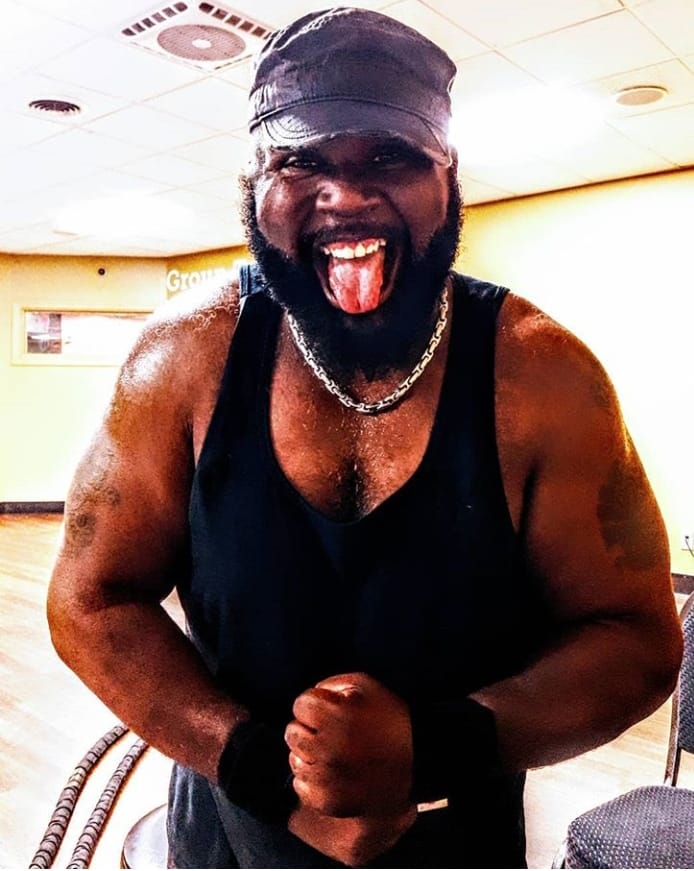
Shawn Cosby flexing after a workout.
Shawn’s War-Face.

SAC: Well my in my day job I am a funeral home attendant. I think working in the mortuary industry, I get a unique perspective on the human condition. I see people everyday who are going through the worst time in their life. The dignity and poise and strength they show during this time is awe inspiring. I also get to see people deal with long held family secrets and simmering tensions. It’s an incredible opportunity as a writer to observe these real-life mysteries unfold. So my experiences have served as powerful inspiration for my work. I think narratively Nathan’s ability to put people at ease is a direct result of his time working at the funeral home. He’s able to get past his suspects initial psychological barriers. They open up to home in a way they might not with a police officer or a traditional PI.

LMS: There’s a lot of great dialog in this book. What can you say to people starting out writing a book about creating good, snappy dialog? And in terms of dialect, slang, etc., where are the good mixes? Like, if you were throwing bits of speech in a cocktail, how are you writing out the recipe?

SAC:  The best advice I can give anyone about writing dialog is spend a lot of time listening to how people actually talk. Sit in a bar and eavesdrop on the two guys complaining about the game. Stand in line for tickets to a movie and pay attention to the couple having a whisper argument. It might seem like you’re being nosy. And you are. But if you take those rhythms that you hear in actual everyday speech and combine them with your own unique verbiage you can create a pretty good sense of what your characters are saying and how they say it. Personally, I like to sprinkle in some slang and dialect among my work but not too much. Usually I’ll have my villains or side characters use a lot of slang. My main character is my mouthpiece, so I try to keep his or her dialog clean and crisp.

LMS: I feel like Nathan can be a series character, without spoiling the ending. He just has room to develop as a character. Can you give your readers your own little spoiler on where you see Nathan Waymaker going? And in that grain, what else is in the pipes for you?

Mugshot of Shawn Cosby and Eryk Pruitt
Shawn Cosby and Eryk Pruitt.

SAC: Well I’d love to see Nathan come back and take on another case. I’ve actually written an outline that details a possible sequel. I guess it all depends on how his first book does. Currently I’m working with Josh Getzler and HSG Literary Agents on my 2nd book.  It’s a standalone crime novel that is currently being shopped around. But I’d love to bring Nathan back. I think he’s an interesting character. He has some archetypal attributes of a standard noir detective but also some significant differences and I’d like to explore those in the future.

Pick up My Darkest Prayer at Amazon, Barnes & Noble, or wherever you normally buy books, and have yourself a pretty damn heavy stocking stuffer.


Gabino Iglesias – Coyote Songs, the Interview

Graffiti on a concrete structure. Photo credit: Gabino Iglesias.
Photo credit: Gabino Iglesias

The Frontera is a land of monsters, cringeworthy creatures that sail the rivers and creep upon the desert, terrorize the villagers. They are born of human nature and of super-nature. And in Coyote Songs, author Gabino Iglesias brings the ghosts of the Frontera to life in the most spellbinding way.

Coyote Songs follows the groove of Gabino’s previous book, Zero Saints, but really evolves the landscape in every way. In fact, for Iglesias, evolution is really the best way to put Coyote Songs. A story about the many faces and experiences of Otherness on the border, it jumps from the imaginative and fanciful folklore personified, to the raw, emotionally stunning realities of the fate of children eaten up for the chance for something better.

I sit down with Gabino and have a few burning questions to ask.

LMS: Hey Gabino. As somebody who’s read your previous book, I of course was looking for similarities, and while maybe they’re in the same universe literarily, there are a lot of differences. Can you talk about what you see as the key differences you were aiming for when you started Coyote Songs? And did you find unintended differences when you’d finished?

GI: I knew I didn’t want to write Zero Saints again, but the universe of barrio noir contains some cohesive elements: pain, violence, multiculturalism, bilingualism, violence, crossing of all types of physical and imagined borders, etc. I knew from page one that those things would be in there, but the rest was entirely new. I wanted women at the core of the narrative. I wanted more magic and weirdness and horror than the first time around. I’ll always walk that line between horror and crime, and now that I knew readers would dig in despite the strangeness and gore, I went all in. The book I’m working on now is also barrio noir, but has nothing to do with Zero Saints or Coyote Songs.

Skeleton hanging on a street sign. Photo credit: Gabino Iglesias,
Photo credit: Gabino Iglesias,

LMS: There’s such a great synthesis between the fantastical and the raw visceral in this book. The Bruja is a perfect example of this. Without giving anything away, it really hit me in the feels, and when the more ephemeral part of it came into play, I was hooked. Did you have any underlying schema for mixing the natural and the supernatural, or was it an organic flow?

GI: Organic flow. Writing is not easy for me, but that part is relatively easy. I grew up immersed in Caribbean syncretism. My abuelita had an entire bathroom for the spirits that you weren’t supposed to use. It was full of candles and religious iconography. It was Catholicism and Santeria and a bunch of other stuff thrown together. She had milagritos sewn to the inside of her clothes. She wore saints on medals. I would find slaughtered chickens in my neighborhood. I had a good friend who acquired exotic birds that were illegal on the island and sold them to paleros and voodoo priestesses. In the immortal words of poet and visionary Issac Kirkman: “If you haven’t seen weird shit in the streets, you haven’t been in the streets long enough.” For me, supernatural and normal are the same thing.

LMS: Coyote Songs is many different parts and perspectives. Did you start this as separate works, or did you start out a single work, and plot it out intending to shift perspectives? And if you can talk specifically about influences for any of the perspectives, like Alma or Pedrito, the Coyote or even the Mother?

GI: I always wanted to write a mosaic novel, but never thought I had the skills. I also hadn’t seen it done much in the extremely pulpy way I wanted but with some decent writing thrown in as well. I think Brian Allen Carr’s The Last Horror Novel in the History of the World opened my eyes. I read that and thought “Fuck yeah! This is it!” That book gave me confidence. I don’t have Brian Allen Carr-level chops, but this was my book, so I only needed my own chops. The perspectives just made sense. I thought about Pedrito first. I love revenge narratives. Then The Mother came to me as the reason and the glue to everything. The rest were born out of specific stories I’d hear or embodied points I wanted to get across.

LMS: Like Zero Saints, Coyote Songs has more than just passing phrases in Spanish. It is used very powerfully, and while it doesn’t detract from the book for non-Spanish speakers, it is indelibly a part of the story. Again, I love talking about methods, so did you set rules for when to use Spanish, or did you just feel for it?

Old iron anvil in a rough wooden barn. Photo by Gabino Iglesias.
Photo credit: Gabino Iglesias.

GI: I published two novellas before Zero Saints, but Zero Saints was me finding my voice. I decided to write what I wanted to write and use Spanish and Spanglish to make it authentic. A lot of people hated it. You can go read the 1-star Amazon reviews to see how much the Spanish/Spanglish bothered them. I don’t care. This is my voice. These are my stories. Escribo como me da la gana. I start writing and the part that come to me in Spanish or Spanglish stay that way. J David Osborne, head honcho of Broken River Books, has never had a problem with it. If you buy a barrio noir packed with frontera people written by a dude named Gabino Iglesias and are surprised at the Spanish in its pages…

LMS: Somewhat related to the previous question, I know, as a writer myself, that the right word can have twelve dimensions, even when you have it in your head. I always assumed that if I knew another language, getting that idea-to-paper lightning strike would be so much easier. But, in having English and Spanish to choose from, is putting that powerful idea down easier… or harder?

GI: It’s easier…until you start the editing process. There’s a new theory out there that says young bilingual kids don’t have two language, that they don’t code switch. Instead, they have one gigantic language in their heads where everything has two or three words to describe it. I’m convinced reading and writing have shaped my brain in the same way. I’ve spent so many years talking to Spanglish speakers that I kinda know just fall into that discourse very easily.

LMS: This book wouldn’t be as good if it didn’t take into account our political realities. And how you did it, hitting it head on, while at the same time making it background to the main action, like horse-kicking racism and bigotry in the face. Do you think, in all the political noise and circuses, that the very real crisis affecting children on the border is forgotten?

Gabino Iglesias at a reading,
Gabino Iglesias.

GI: Society has a very short memory and equally short attention span. Things fade away very quickly. I dislike that. We need to stay angry. We can’t let border politics, inhumane immigration policies and attitudes, and things like the #MeToo movement fall by the wayside. I try to contribute to that with my fiction. Fuck racism. I see it everywhere. Hell, I get called a beaner and a spic regularly by guys who wouldn’t say it to my face, so I’m not worried about forgetting about it any time soon. And women are the core of Coyote Songs. There are many reasons for that. Hopefully readers can identify them without me having to spell it out.

LMS: The poetry in the book is fantastic. The visuals, and the flow of those visuals, I think, make this book an upper-echelon book. Take us through the time you were writing it. What was the music playlist? And were there any other writers, directors or cinematographers through whom you were putting yourself?

GI: Oh, man, I was submerged in darkness for this one. I do this thing where I listen to nothing but blues or flamenco or jazz for a month. For this book, I always went with heave, dark stuff. I listened to a lot of black atmospheric metal. And things like Loscil and Robert Rich. Weird mix, but it worked. Here’s a taste of albums that come to mind that were on repeat:

Eldamar – A Dark
Caladan Brood – Echoes of Battle
Loscil – Stases and Endless Falls
Robert Rich – Vestiges and Nest
Musk Ox – Woodfall
I also had Takuya Kuroda’s Rising Son and Ryo Fukui’s Scenery and A Letter From a Small Boat…and some other stiff because music is life. Then, when not writing, I would switch back to my everything schedule. Those are the few I remember, but there were more. Lots more.


Pick up Coyote Songs from Amazon in Kindle or paperback here.

Storm Debris (a flash fiction piece.)

Hey everyone,

In my continuing bid to document my writing life for you, and not let all the big news go by, I am happy to present to you a short, flash story that’s been published by the preeminent journal of twisted taste Shotgun Honey. The story, “Storm Debris” draws from my years of experience in disaster work, and my love of a good vengeance tale.

Shotgun Honey logo

This is admittedly a short post. The bulk of this post are in the link below:

https://www.shotgunhoney.com/fiction/storm-debris-by-liam-sweeny/

Keep tuned for a lengthier post. More to come.

Presiding Over the Damned – Interview at The Big Thrill

A little while ago, Tim O’Mara sat down with me (digitally) and he had questions. Good questions, all. I tried to answer them to the best of my abilities, but I must confessed, some were real wringers. Without further ado, I am providing the link to the original interview.

If the phrase “ripped from today’s headlines” weren’t so overused—and possibly trademarked by those Law & Order folks—I would use it to describe Liam Sweeny’s second Jack LeClere novel, PRESIDING OVER THE DAMNED (out now from Down & Out Books). Since I’m not going to use the phrase, let’s just agree that Sweeny’s novel could hardly be more timely than it is. Jack, a homicide detective in Upstate New York’s New Rhodes Police Department, not only has to deal with the lynching of a young black girl, he also has to navigate internal police politics and outside activists/agitators, all while recovering from the events of his last case, where his family was more than threatened.

Continued at http://www.thebigthrill.org/2018/08/presiding-over-the-damned-by-liam-sweeny/

Swan (Fake Stories About Real Pals)

The Leslie speaker surged and recessed, pushing out the sounds of the Hammond B3 like a rip current in a hurricane. Swan walked a funk-line with his left hand and peppered Jackson’s guitar riffs with the acrobatics of his right. He was surprised to hear DeeDee’s brushes on the drums, what with the firepower coming out of the rest of the gear. They fought about her bringing a mic, but only because he didn’t want to sing over her drums in the only PA at the gig. The crowd was telling him he didn’t have to worry. A glance at DeeDee was telling him she couldn’t hear herself and was playing by wire. She’d have to get a bigger slice of the night’s tips if he wanted to keep her next week.

Hammond Organ

The Bleecker Café was a political hangout in Albany. It was a quiet spot, where the music was no more than live background to deals struck in the shadows of the Capital building. Swan sometimes wondered, on a big tip night, what he was being paid to forget he’d heard. But that night was the night that the legislature took summer recess. It was the last night out in the city before they went home to their districts. Their mouths were open for drinks and gossip and off-season Auld Lang Syne, and they were on the floor, dancing like they knew how to, and throwing smiles, requests, and most importantly, tips around.

Swan turned over and aimed his voice low, “C sharp.” MacAvoy was a new pick up. He came in to a biker bar down by the river during one of the open mics Swan subbed for. He liked the cat’s blues lead, but maybe more the fact that, at the open mic, they seemed to be the only two musicians that gave a fuck. Going by MacAvoy’s inability to follow a chord progression or key change, he had quite a few fucks left to give. But at least he turned down when he was off in the weeds. Jackson had a spoon on his strings, improvising a slide. The crowd dug it, marveling at the ingenuity. They didn’t know Jackson couldn’t keep his hands on a real slide to save his life.

They played out the set and took a break around eight. Swan knew the waves of the gig, no matter what was happening down the road. The nine-to-twelve crowd was going to be crazier, but their requests were going to be closer to the songs a player has to put in their starter kit. Early crowds around there had a “let’s stump the band” feel. Swan wouldn’t have had it any other way.

Swan, MacAvoy and DeeDee were outside on the open patio. A penetrating rain was infusing the night air with the smell of ozone and the rejuvenation of an arriving cold-front. Swan even wondered if he had a sweater in the van.

“I’m trying to catch you, Swan, I really am,” MacAvoy said. “Can you play a few more blues tunes? Give me something I can go off on?”

“I could, but you can’t just go around being Stevie Ray Vaughan all day. You need to know the changes.”

“I know. I just don’t want to let anyone down.”

“Don’t worry. No one’s listening to you.”

“Oh, Swan, that’s rough,” DeeDee turned to MacAvoy. “Don’t listen to him. You’re doing good.”

Swan took out a cherry cigar. “When you get good, when you know the progressions and you know those songs, those deep cuts, you’ll play louder, and people will hear you. I’m not trashing you, it’s good that you play low. You don’t know a song and you step back. That’s what you’re supposed to do. But learn the songs.”

MacAvoy pulled the cellophane off a fresh pack of cigarettes. “I’m not used to these crazy chord-change songs,” he said. “Everyone I know rocks the one-four-five.”

“And that’s good when your set-list is five songs long, like those shows you guys set up. But doing a set like tonight, we’re going to go through sixty-, seventy songs. You can’t just sit there and jive out a one-four-five sixty-times, you know?”

Swan reached in his pocket for his black, plastic film canister and flipped aside the lid with his thumb. He pulled out a bowl made from threaded pipe, washers and the only piece he had to buy, the piece that right then was packed with sticky skunk bud. Even the screen came from the bathroom faucet of his boarding house.

“Mac’, go get Jackson. He’ll be a motherfucker if he don’t get any of this.” MacAvoy flicked his embers to the road and tucked the butt into his pocket before he dipped back in to pull Jackson off the two-for-ones.

“I’m gonna make him eat those cigarette butts.”

“Why does he do it?” DeeDee held her own smoke up to the glow from the streetlamp. “Put ‘em in his pocket?”

“He said he’s trying not to litter.” Swan leaned in and nudged DeeDee with his shoulder. “After the next set we’ll take him to the landfill and leave him there.”

They laughed. “You’re terrible,” DeeDee said.

“He’s a good cat,” Swan said. “He’s young. “When I was his age, I was in L.A., playing at a club that Pablo Escobar owned. I ever tell you that one?”

“I’ve heard it,” she said. “Not from you, though.”

“Oh yeah, Jackson showed up back—” Swan turned as the door opened and Jackson came out, trailed by MacAvoy. “Jackson, when did you show up in Escobar’s place?”

“I think it was around what, ’90? ’91? I just got divorced from Sandy, so, about then.”

“The place had iron bars on every window and cameras everywhere,” Swan said. “And you couldn’t take pictures.” He took a hit and paused his remembrance. “They paid us to

play Colombian music. I remember I had to go out and learn it. The owner gave me five hundred bucks when I showed up and told me to give it to a guy down the street. I spent a couple days with that cat learning folk rhythms. There were a thousand and twenty-four, and they wanted them all. But then they paid me good, man, real good. They were getting me whatever I wanted—drinks, drugs, girls—I just asked. And you showed up.”

“That owner was going to shoot me, I thought,” Jackson said.

“He told me he was going to shoot us both,” Swan said. “Me for bringing you. Fuckin’ Pablo Escobar’s joint.”

They stood out and watched the rain, and the voices that assumed themselves to be whispers were revealing themselves to be voices and gregarious shouts inside. The cabs were stopping more frequently, letting out new patrons in pairs. The nine o’clock crowd shook the rain off their umbrellas as Swan and the crew passed the plumber’s pipe, blowing the smoke toward the outside kitchen vent to let it mix with the smell of fried onion rings and chicken tenders.

Swan glanced down the street, exhaled, and passed the pipe to MacAvoy.

“That’s why ya gotta know all the songs.”

Spoiler Alert: Chris Dewildt, “Suburban Dick”

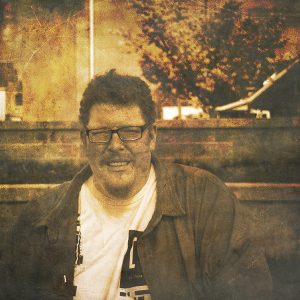
Chris Dewildt - Author Photo
Chris Dewildt

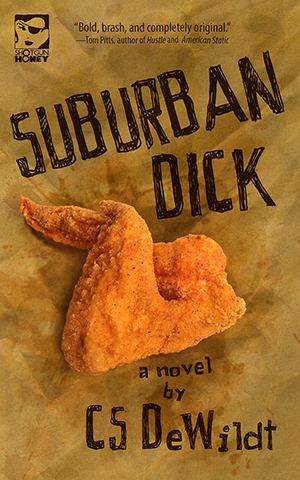
Suburban Dick is about the adventures of Gus Harris, a private investigator (“dick”), caught between the woman he can’t get serious with and the family life he ruined over her. The parents of a missing high school student send Gus on a wild trek through the seedy underbelly of Horton High’s wrestling program. The blood doesn’t stay on the mats.

SA: I’m a big fan of setting in any story. Suburban Dick takes place in a town called Horton. Let’s say I moved there a year ago, right next door to Gus Harris’s crash-pad/office. What do I know about Horton that someone passing by on the highway couldn’t know?

CD: It’s a town full of secrets, but I can’t give any away here. I’ll tell you it’s a fictionalized version of the small town I grew up in, and it’s been the setting for three of my books so far. I’ll also add that it seems to have a strangely high level of low lives and crime. Maybe it’s something in the water?

SA: Gus was a Horton Police officer before becoming a private eye. Was there a case that stuck with him, one that help shaped his investigative approach?

CD: There are two specific cases and they’re both mentioned in the book. One involved a dead girl when Gus was still a kid, it was local news and an innocent guy nearly went down for what in the end was a tragic accident. The media surrounding that case spurred his interest in police work, but also showed him a dark side, the fact that an innocent man was bullied and beaten into confessing to a non- existent crime. It made him aware of a path of least resistance in police work, which he vows to avoid. The second case is the one that ultimately led to his leaving the force and it again has to do with integrity. Gus is pressured by his superiors to look the other way regarding a local politician’s kid, classic nepotism. Gus is new to the force at the time and never really forgives himself for his lack of integrity. Despite his flaws Gus has a deep seated desire for truth and justice.

SA: I think every story has a theme, but that’s my opinion. I sensed a theme of “getting what you want at any cost.” I see it in Coach Hanson (the main baddie) but also in Gus when he needs something. If you were going for a theme, was it this? And what’s your take on having a “line” and having a justification to cross it? Do Gus and Coach Hanson both have a line that they cross?

CD: Without giving too much away, it’s pretty clear that Hanson crossed the line with the Horton wrestlers. Greed is his motivator, but ultimately it’s not the money itself, but the adulation of the community and school. This relates to the theme that I saw emerge which is about protecting what’s valuable, for Hanson obviously he’s protecting both his legacy and his cash cow. Gus on the other hand is protecting his family, his loved ones. There really is no “line” with regards to protecting the people Gus cares about and he demonstrates that a few times in the book.

SA: Another theme I noticed was a real “monster” theme, and you touched into a real fear about performance enhancing drugs. And it ties into the earlier theme I mentioned. What do you think drives a young athlete to dope? Is it just the competitive edge, or is it something else?

CD: Ha! Glad you picked up on the monsters. But as for performance enhancers, yeah, it’s the edge and what comes with it: wins, scholarships, maybe a payday down the line. We live in a culture that puts a very high premium on athletic ability, so it’s really no surprise that people want to give themselves that edge. Then you have the types of parents who get a vicarious thrill living through their kids and of course there’s going to be that cohort that who will put that success before the welfare of their kids.

SA: It definitely feels like Suburban Dick is the first of the “Gus Harris” series. I’m hoping you can get more into Gus’s complicated relationship with the Horton PD. Is there anything you can say about that part of his life to get us tuned in?

CD: I’ve got something happening for Gus but to be honest I’m not sure. I may relocate him. I live in southern Arizona and I have yet to write a book set here so that could be fun. Otherwise we can expect some more of the same. He’ll have ruined another relationship and managed to squander whatever goodwill he’d managed to generate in Suburban Dick. Hopefully, he’ll learn something from it.


You can find Suburban Dick at Amazon, Barnes & Noble and from the publisher, Shotgun Honey.

“Jailbreaker in the Briar Patch” Published in Shotgun Honey

It’s always an accomplishment to get a story in Shotgun Honey. With three tough-as-nails editors and a 700-word limit, SH features truly the best of the best. It is an honor that “Jailbreaker in the Briar Patch” made it.

I ran. I ran fast as I could, tripped over my laces and eased my body into forward leaps that turned into junk street somersaults. I ran past Ritchie’s Market, past Harry Dzembo as he held the

Liam Sweeny - Author Photo
Liam Sweeny

broom in his hands, slack-jawed. I heard him ask me what the fuck, but I was gone, man. I turned corners by radar; the blood in my eye sockets made my horizon a magenta mudslide. I went by the sounds of cans and bottles crashing against each other, surest bet I was heading into the bums’ squat. They wouldn’t dare lurk in there, and the cops would call for back-up first. I had some time to camo up.

You can read the rest of it here

.

‘Presiding Over the Damned’ is available for Amazon Pre-Order

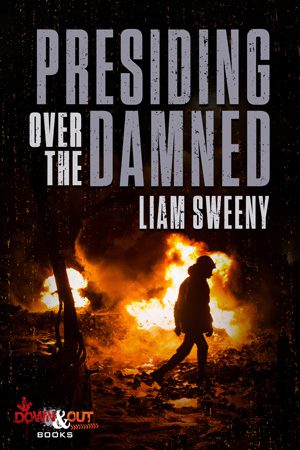
In the sequel to the Jack LeClere detective series, Presiding Over the Damned, Jack must face his most explosive case… and his most heartbreaking victim.

It is available for Pre-Order from Amazon

From PRLog:

TAMPA, Fla. – May 1, 2018 – PRLog — Down & Out Books is pleased to announce that PRESIDING OVER THE DAMNED, the second Jack LeClere thriller by Liam Sweeny, will be published on August 20, 2018 in trade paperback and ebook formats.

About PRESIDING OVER THE DAMNED …

An arson in New Rhodes reveals the body of Julia Mae Jefferson, an eight-year-old African American girl in the city’s North Central District. Jack LeClere, the top homicide detective in the New Rhodes Police Department, is paired with a new partner for the case, Clyde Burris, a former New York City homicide-turned- New Rhodes PD Internal Affairs detective. Jack and Burris have a mutual distrust of each other, but that’s the least of their worries. In the heat of the ashes of that row-house, the search for a brutal killer awaits.

Presiding Over the Damned Book Cover

Julia Mae’s world was one of neglect—of a child, and in fact, many of the North Central children—falling through the cracks. Jack and Burris follow her through those cracks and discover an underbelly of abuse and an industry of exploitation in the guise of a daycare center called Mount Vision. Jack and Burris, through their own struggle to build trust in a city where little can be found, find something that even the most cynical activists could never have imagined—a true wolf in sheep’s clothing, and a monster with an SS tattoo and a rebel flag in his window.

To give Julia Mae justice, Jack, Burris and Marcus Ellison must make a temporary peace, and the city must come face-to-face with the fruits of its indifference.

Meet the author …

Liam Sweeny is an author and graphic designer from the Capital Region of New York State. His work has appeared both online and in print, in such periodicals as Spinetingler Magazine, Thuglit, All Due Respect, Pulp Modern and So It Goes: the Literary Journal of the Kurt Vonnegut Memorial Library. He is the author of the collection Dead Man’s Switch and the first detective thriller in the Jack LeClere series, Welcome Back, Jack.

Celebrating seven years as an independent publisher of award-winning literary and crime fiction, Down & Out Books (https://downandoutbooks.com) is based in Tampa, Florida. For more information about the book, to request a review copy of the book, or to inquire about an interview with the author, contact lance@downandoutbooks.com.

ADR Talks With Liam Sweeny, Author of Street Whispers

Liam Sweeny is the author of Street Whispers, a short story collection out today. It’s an eclectic collection of pulp, grit and noir stories inspired by the Capital Region of New York, a rust-belt crossroads in the shadow of the city that never sleeps.

ADR: The stories in your collection mostly take place in the Capital Region of New York state, nearby to Albany and Troy for those unfamiliar with the area. Are there any other authors writing about this region? Why do you find that the region is a good setting for crime fiction?  

LS: I live in the city of Cohoes, which is north of Albany, across the Hudson River northwest of the Troy city center. The area was written about famously by the author William Kennedy in the books Ironweed, Legs, possibly others, I’m not sure. Caleb Carr, author of the Alienist series, lives in Rensselaer County, Troy’s county, and he wrote the book Surrender New York, a story that takes place in a fictionalized version of Rensselaer County. James Howard Kuntzler’s World Made by Hand dystopian series takes place in a fictionalized city just north of here. And there was the movie The Place Beyond the Pines with Ryan Gosling, Bradley Cooper and Eva Mendez was about, and shot in and around the Capital Region city of Schenectady.

The Capital District is a very old place. Albany, in its incarnations, has been around for four hundred years. It was a fort, a Dutch trading post, a barrier to the British conquest of New England (the capital district includes Saratoga.) The Continental Army set up camp in my back yard, quite literally. And later, with the construction of the Erie Canal, this area boomed, and was home to many firsts, specifically in industrialization. Troy was the first steel capital before Pittsburgh, and Cohoes was the home of the first industrial textile mill.  Troy also had a few cultural claims to fame, the “Home of Uncle Sam,” and the home of “The Night Before Christmas,” and it’s a mark of belonging in Troy to know the story of meatpacker Sam Wilson and the Troy Sentinel newspaper article in 1823.

It boomed and it busted, and is struggling to boom again, to hide the scars of vacant concrete factories and the curbside litter that speaks to the dissolution of neighborhoods that, at one time, took care of their streets. We have nanotech and polytech and, I think, seven or eight colleges, and we have people working three jobs to afford a studio apartment, basic bills and food for the week. And that’s something that’s happening everywhere. But people here still wake up each morning with pride that they live in what could rightfully be considered a cradle of America.

As one last note, this area is the intersection of the Interstates 90 and 87, which make it a crossroads of the Northeast. We get enough drift from that to keep things interesting.

ADR: Which other short story writers did you consider influential on your work? Who else are you reading in crime fiction right now?

LS: I was named after Liam O’Flaherty, and I was exposed to some of his stories at an early age. I mean, they’re dark as hell. Grit like a sanding belt, and they opened my eyes up to the period in Ireland that he wrote about. It was one of the first times I was awakened from the fictions we have in this country to a new reality: The Ireland of shamrocks and leprechauns to the one of stark Catholicism and the visceral sacrifice of a man to cold industry. Kurt Vonnegut was another influence, I mean, not the same as O’Flaherty, but I liked his ability to dash your expectations of a character’s moral standing. He showed the fragility of judgmentalism. In my time of coming out with plot twists in short stories, I could always feel that groove. Also, Steve Weddle, and his book Country Hardball, showed me a side of country life that resonated with the fact that deep country is only ten miles out in any direction from here, and made me want to set stories in some of the outlying towns.

Right now, I just finished Joe Clifford’s Broken Ground, which isn’t out yet, but is in the Jay Porter series that I’ve been following faithfully. I also just finished Eryk Pruitt’s What We Reckon, which was an incredible standalone, and I hope he follows that up. I’m currently reading Tom Pitts, American Static, and am just getting into Jen Conley’s Cannibals. I’m waiting for Ryan Sayles’s Albatross. I am thinking of re-reading Les Edgerton’s Death of Tarpons, which may not specifically qualify as crime fiction, but it is told by a master of the genre, so I’ll count it.

Read the rest of the article on All Due Respect